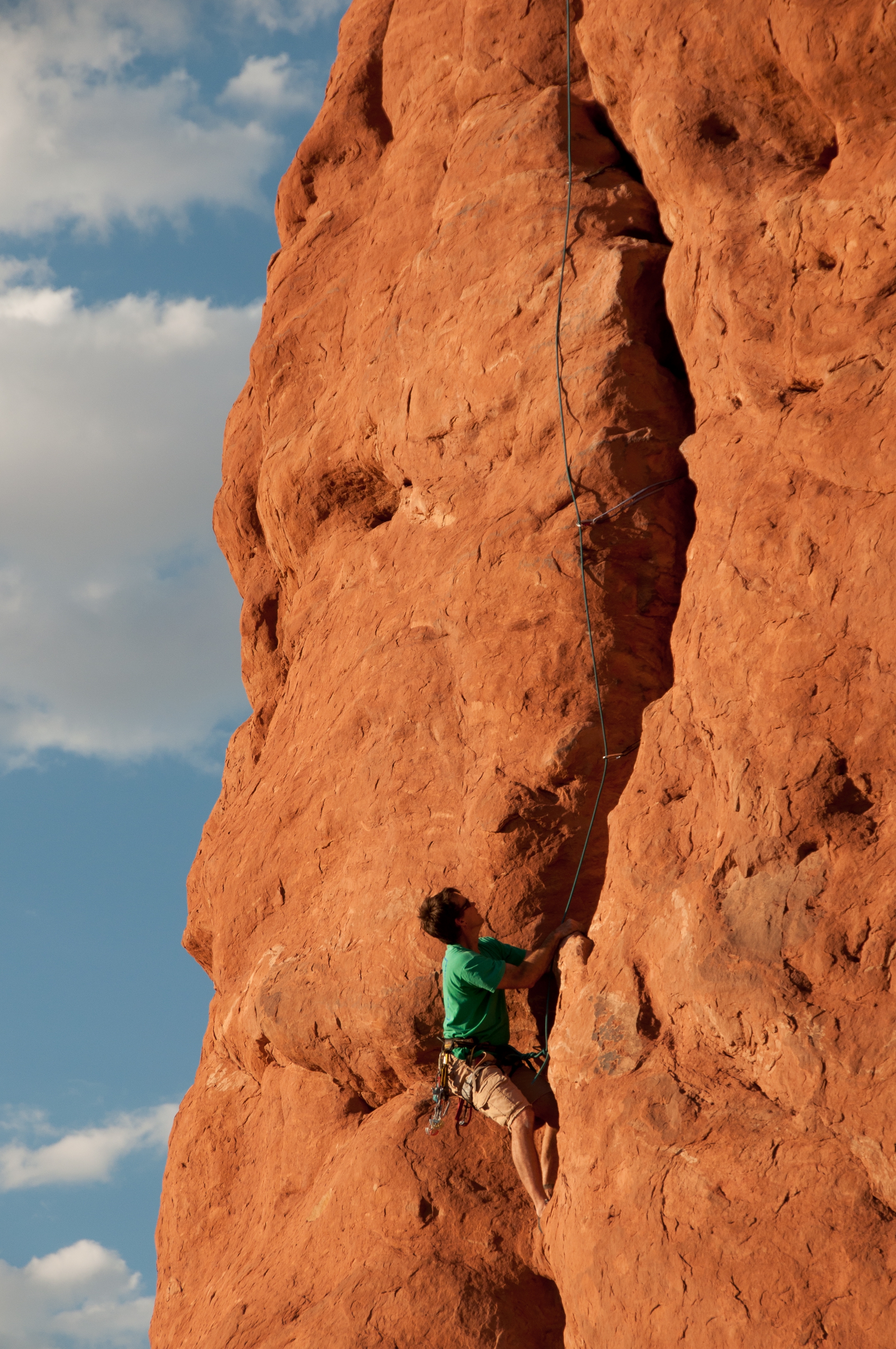
The rock at Arches offers excellent climbing opportunities, despite its sandy nature. Most climbing routes in the park require advanced techniques.
Arches National Park developed a Climbing and Canyoneering Management Plan (CCMP) in December 2013 in order to protect the natural environment and the park's resources and visitor experience. Primary actions of the CCMP are the implementation of group size limits, climber registration, improved climber education program, safety standards, and climbing access routes. We ask all climbers to act responsibly and observe park regulations.
Regulations
- Rock climbing groups are limited to five persons per group.
- White chalk is prohibited. Chalk must be similar in color to the rock being climbed.
- The physical altering of rock faces by chiseling, glue reinforcement of existing holds, gluing of new holds, and the intentional removal of lichen or plants from rock are prohibited.
- Rock climbing should be mostly free climbing or clean aid climbing.
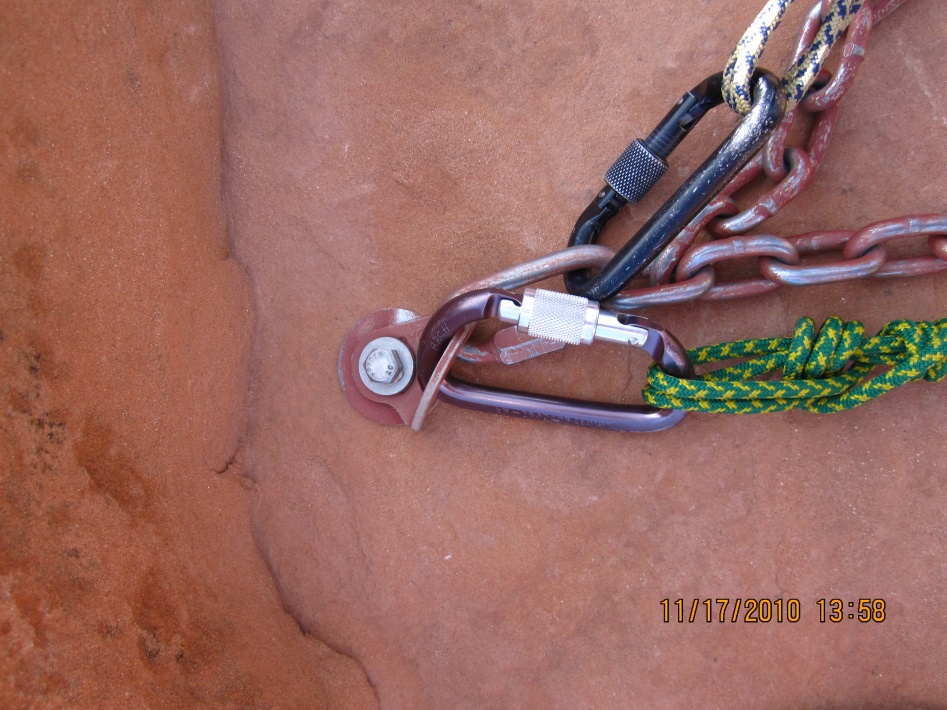
- Any new installation of fixed gear requires a permit. If an existing item or fixed anchor is judged unsafe, it may be replaced, in kind, without a permit. Bolts, hangers and chains must be painted the color of the rock surface (see photo).
- Protection may not be placed with the use of a hammer except to replace existing belay and rappel anchors and bolts on existing routes, or for emergency self-rescue. The use of motorized power drills is prohibited.
- If an existing software item (sling, etc.) is unsafe, it may be replaced. Software left in place must match the rock surface in color.
- Leaving fixed ropes in place for more than 24 hours is prohibited, unless the park has been notified.
- Slacklining (or “highlining”) and BASE jumping are prohibited.
- Guided rock climbing services are prohibited.
- Use of motorized drills within wilderness boundaries is prohibited. Use of motorized drills outside of wilderness boundaries requires a special use permit.
- Overnight camping in Arches is only allowed in the Devils Garden Campground and in designated backcountry camping sites and zones. Permits for the designated backcountry campsites and zones can be acquired at the visitor center up to seven days in advance.
New Route Establishment
Establishment of new climbing routes is allowed. However, climbers must obtain a special use permit before establishing any new routes requiring the installation of new fixed gear. Travel to and from new routes must be on rock, within drainages or sandy washes, or on designated trails.
To apply for a new route, email us to request a new fixed gear application.
Climber Registration
All persons planning to climb in Arches National Park are encouraged to register by obtaining a free permit. There are no daily limits on routes, so climbers can get their permits on the day of the climb. Registration is free, it increases climbers' safety, and helps the park maintain desired conditions in the backcountry zone. It is in your best interest to register.
Climbers have two options to obtain permits:
Climbing Safely
The National Park Service cannot guarantee the safety of park visitors. Safety remains the sole responsibility of the climber. Climbers should understand the inherent danger of the activity, have basic knowledge of self-rescue methods and plan accordingly. Climbers should not attempt routes that are not within their abilities or those within their group.
Check the weather first. Obtain forecast information before beginning your climb and observe changing weather conditions. Thunderstorms can develop quickly bringing lightning, hail, rain, slippery rock surfaces, and hypothermia. Summer days can reach a scorching 100°F.
Do your homework and know your route. Most climbing in Arches is technical and requires advanced skills. Arches National Park offers sustained multi-pitch towers, easier one pitch towers, and hard cracks on amazing buttresses. Routes are typically sandy or in soft Entrada Sandstone. Many websites, guide books, and local gear shops are available for specific route information.
Inspect all fixed gear. The NPS explicitly disclaims all responsibility for the safety of equipment, bolts, or anchor systems in the park. The NPS does not maintain anchors. If an existing item or fixed anchor is judged unsafe, it may be replaced to enable a safe rappel when no other means of descent is possible, to enable emergency retreat, and during self-rescue situations, in kind, without a permit. When existing anchors are deemed to be unsafe, a reasonable effort to remove the existing hardware will be made and existing drill holes will be used in the installation of replacement fixed anchors whenever possible.
Before placing fixed anchors on a route, think seriously about whether the route warrants them. Only place fixed anchors as a last resort. Please notify the NPS when replacing fixed gear to help keep an up to date inventory of the park's fixed gear.
Be prepared to self-rescue. Cell phone service is limited in the park. Make plans for self-rescue or get assistance from other climbers should an unexpected incident arise. Clearly and loudly call out for help. If a phone is available, call 911. Be prepared to tell the dispatcher the rock formation, climbing route name, nearest landmark and meeting place so that you can direct rescuers to the accident site. Park staff, if available, will provide assistance to the limit of their abilities;however, help may not arrive on-scene for several hours.
Report significant hazards and any injuries to a ranger, even those that do not require assistance, so that future climbers can be warned of the situation. The closest medical facility is Moab Regional Hospital. Watch for snakes, spiny plants, poison ivy, biting insects, and falling rocks. Always wear a helmet!
Good Climbing Practices
Only by following a low-impact climbing ethic can climbers protect the park's outstanding natural features and biological diversity for future generations. To accomplish this goal, renew your commitment to leaving no trace and adopt this code of ethics for low impact climbing:
Tread Lightly. Practice "Leave No Trace" ethics. Pack out what you pack in. Don't mark on rocks; scratches and carvings are considered graffiti which is against the law. Use of a bag system for human waste is recommended. Supplies are available for a minimal charge at the visitor center.
Your steps matter! Help protect the park's sensitive desert soils. Travel to and from routes in sandy washes (where water flows when it rains), on rock, or on designated trails. Approach trails to some climbing routes will be established with labeled brown carsonite posts. Don't create multiple paths to the same cliff (known as "social trails"), even if it is the shortest distance to your climb. Short-cutting damages vegetation, increases soil erosion, destroys animal burrows, and promotes the spread of exotic plants.
Be considerate of other visitors. The majority of Arches' rock climbs are very close to the road or located in busy areas of the park. Do your part to maintain a low profile. During peak visitation, spring through fall, climbers are recommended to park in established pullouts and parking lots.
Consider leaving your pet at home. While pets are allowed in the park, they must be on a leash at all times and are only allowed in developed areas like campgrounds and paved areas. They are not allowed on or off trails. Desert heat can be deadly to your pet. Temperatures over 65°F can turn the inside of your car into an oven, and animals tied outside to your car can suffer just as much.
Experts use gear expertly.It is essential that fixed gear be of high quality and the installers be experienced and skilled in setting bolts to ensure not only the first ascent party's safety but ensure the safety of future climbers. Please keep the following best practices in mind regarding fixed gear:
- We recommend hardware for new and replacement anchors be modern climbing-specific hardware and of a length adequate for rock conditions at the installation site. Quarter-inch bolts are highly discouraged.
- Climbing-specific hangers are recommended.
- Homemade hardware is prohibited.
- It is always preferable to use the old bolt hole rather than adding a new scar. Only in a worst-case scenario should a new hole be added.
- All old holes will be filled with epoxy and topped with sand to best camouflage the unused hole.
- Software left in place is required to match the rock surface in color.
- Bolts, hangers and chains must be painted the color of the rock surface or primered brown before installation.
Climbing Closures
It is your responsibility to know all route closures. Some routes or features inside Arches National Park are closed to rock climbing, temporarily or permanently, and access and/or egress trails may be rerouted to avoid harm to wildlife and other resources. Check this list or the visitor center's climber kiosk for updated route closures every time you register to climb. Closures are strictly enforced.
Permanent Closures
- It is prohibited to climb, scramble or walk upon, wrap webbing or rope around, or rappel off any named or unnamed arch with an opening greater than three feet.
- Balanced Rock is closed to climbing.
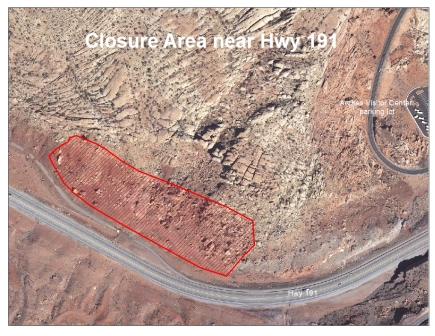
- Bouldering, rock climbing, rock scrambling and other similar activities are prohibited in the area known as "Arches Boulders" or "Highway 191 Boulders" (see photo).
Temporary Closures
The craggy rock outcroppings of Arches National Park are excellent habitat for birds of prey. Raptors are sensitive to human disturbance, so climbing routes are frequently closed between January and August -- the period of many raptors' breeding seasons. Even when climbers do not have direct contact with eggs, young, or adults, behavior such as shouting and other noises are disturbing enough to cause a parent bird to abandon its nest. Intentionally disturbing wildlife nesting, breeding, and other activities is a violation of Title 36 of the Code of Federal Regulations (Section 2.2 (a) (2)). Thank you for your assistance in protecting these magnificent birds. By coming to Arches and following these recommendations, you are a vital component to the success of maintaining a healthy raptor population. The following list of closures will remain in effect through the time specified below, or until surveys determine habitats to be unoccupied by sensitive wildlife.
See Arches website for a list of current route closures.
Definitions
Access route is the route from an existing parking area, trail or road in which a climber or canyoneer walks to the base of a climb or beginning of a canyoneering route. Routes are not formally maintained.
Anchors can be any way of attaching the climber/canyoneer, the rope, or a load to rock or tree, by either permanent or temporary means for belaying or rappelling. The goal of an anchor depends on the type of climbing under consideration but usually consists of stopping a fall, or holding a static load. Anchors can be either retrievable or permanent.
Bivying (also known as bivouacking) is the act of camping overnight while on a climbing route above the ground. This may involve nothing more than lying down or sitting on a rock ledge overnight, or use of a cot or 'portaledge' suspended from anchors to serve as a bivouac.
Bolt is a permanent, man-made article that requires a hole to be drilled or hammered into the rock for its placement, usually consisting of a glued-in or expansion bolt. Bolts are small anchoring devices (usually 3/8" diameter by about 3" length) used to protect climbers where there are no cracks or openings for other types of protection.
Bouldering is a style of rock climbing undertaken without a rope that requires the use of specialized equipment (rock climbing shoes, crash pads, etc.) and normally limited to very short climbs over a crash pad so that a fall will not result in serious injury. It is typically practiced on large natural boulders or at the base of larger rock faces. Chalk is typically used.
Chalk is the common name for magnesium carbonate powder, which climbers carry in a pouch (chalk bag) at the waist. It dries the hands and is used in rock climbing in the same way it is used in gymnastics, to improve grip.
Clean aid climbing is aid climbing without the use of bolting gear, pitons or other gear that scars the rock or becomes fixed after ascent.
Egress or Exit route is the route from the completed climbing or canyoneering route back to the parking area. Routes are not formally maintained.
Fixed belay/rappel station or "anchor systems" shall be deemed any configuration of fixed anchor hardware (requiring rock alteration for installation) or software placed at the top of a pitch or rappel for the purpose of belaying or placed for the sole intent of rappelling. The hardware or software is left behind.
Fixed gear is any man-made article, either hardware or software (webbing, rope, cordelette, etc.), that is used to aid ascent or descent, or as protection, and is left on the route by a climbing party after the completion of the climb.
Free climbing (also known as Traditional climbing) is a minimum-impact approach that employs chocks, stoppers, nuts and camming devices, rather than pitons or bolts, for protection or direct support. These are climbing aids that are removable and do not damage the rock. Traditional climbing is how the sport of rock climbing has been practiced since its inception, and has strong historic associations.
Hardware is climbing equipment placed in cracks or on faces to protect climbers from falling. This specialized equipment includes wired nuts, camming devices, hexes, pitons and bolts.
Nut (or chock) is a metal wedge threaded on a wire, used for protection by wedging it into a crack in the rock.
Piton (also called a pin or peg) is a metal spike (usually steel) that is driven into a crack or seam in the rock with a hammer, and which acts as an anchor to protect the climber against the consequences of a fall, or to assist progress in aid climbing. Pitons are equipped with an eye hole or a ring to which a carabiner is attached; the carabiner can then be directly or indirectly attached (through more equipment) to a climbing rope.
Rap rings are made of a single ring of aluminum or steel. Soft aluminum rings are prone to destruction as you pull your sand-impregnated rope across the metal. Rap rings are often found on anchors in canyons.
Rock alteration is the intentional removal of rock from its natural position, drilling, chipping, or gluing of hold.
Rock climb is any independent line of ascent of a rock face. A climb may follow a crack system or other natural features, or it may strike out across a "blank" face. A climb is considered to be created when it is first ascended, and is usually given a name by the first ascensionist. The climb is typically recorded and described in a guidebook or internet site so that other climbers can identify and climb the route.
Slacklining/highlining is defined as walking on a rope, webbing, or other line that is tensioned horizontally between two points such as rock formations, trees, or any other natural features. Height of the rope above the ground is immaterial.
Spring-loaded camming device (also SLCD, cam) is used for protecting a climber's fall. It consists of three or four cams mounted on a common axle or two adjacent axles, so that pulling on the axle forces the cams to spread farther apart. The SLCD is used by pulling on the "trigger" (a small handle) so the cams move together, then inserting it into a crack or pocket in the rock and releasing the trigger to allow the cams to expand. Camming devices can be manually removed and should leave no trace of use on the rock.
Stopper is a wedge-shaped nut or a knot used as passive protection while rock climbing.
Technical rock climbing is defined as ascending or descending a rock formation utilizing specialized rock climbing equipment.
Vegetation alteration is any intentional removal of vegetation from its natural position, destruction, or damage of vegetation.
Webbing is synthetic flat rope that is used to tie around anchors.