Fishing in Rocky Mountain National Park
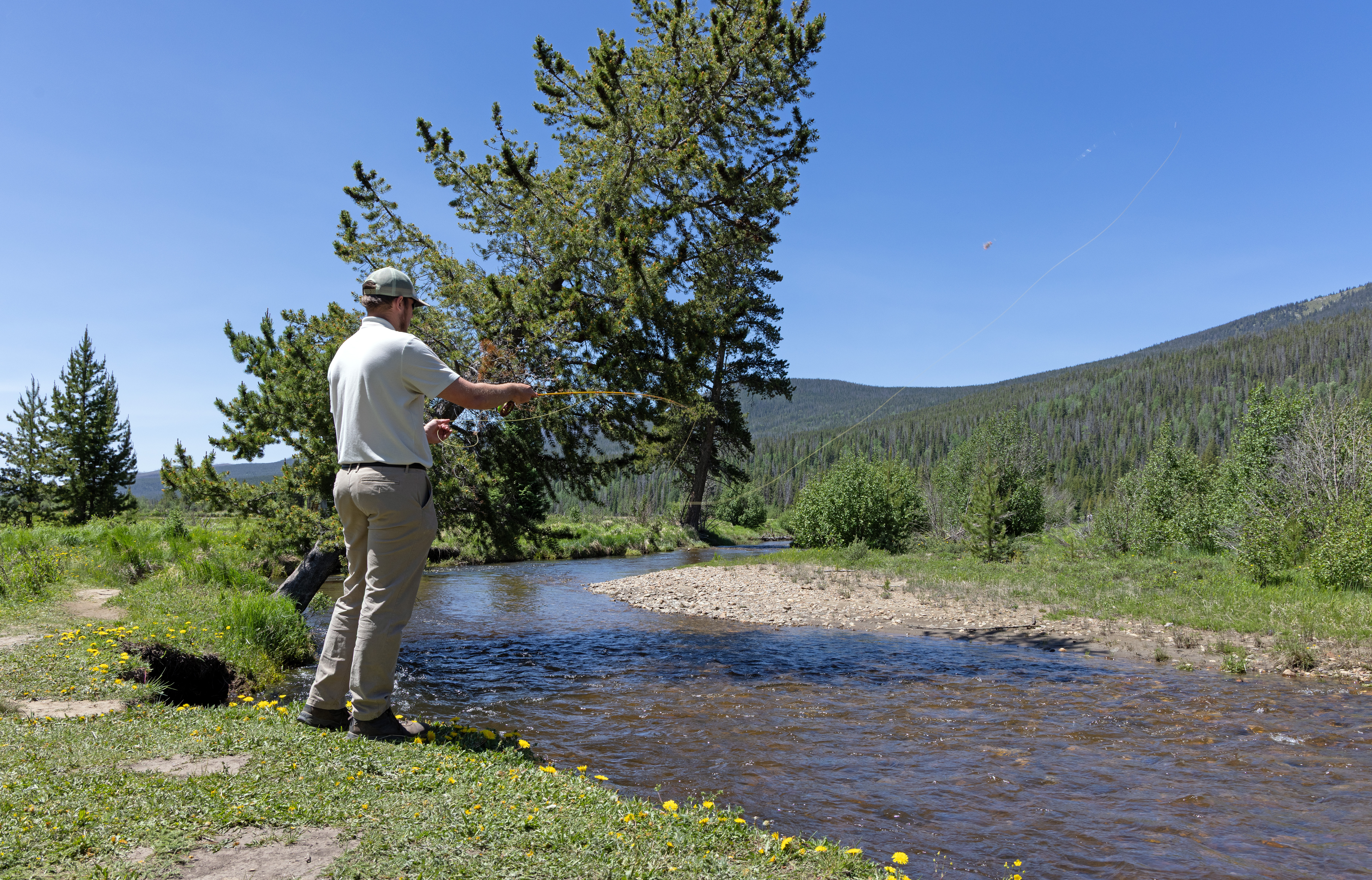
Fishing is a fun activity people of all ages can enjoy year-round. Some popular fishing locations include Sprague Lake, Moraine Park, and the Kawuneeche Valley.
In lakes and streams in RMNP, there are populations of brown, brook, rainbow, and cutthroat (Colorado River and Yellowstone) trout, as well as suckers and sculpin. Most of Rocky's high altitude lakes lack reproducing fish populations due to cold water and lack of spawning habitat.
Before your next fishing trip in Rocky Mountain National Park, make sure you know the park's rules and regulations and understand which waters are open for fishing and which waters are not.
Fishing Licenses and Fees
A valid Colorado fishing license is required for all persons 16 years of age or older to fish in Rocky Mountain National Park. Fishing licenses can be purchased at a variety of locations in communities outside of the park.
Method of Capture
- Each person shall use only one hand-held rod or line. A 'second rod stamp' is not honored in the park.
- In waters designated as catch-and-release, barbless hooks must be used. This helps protect and maintain fish populations.
- The use of lead sinkers or other lead fishing materials is strongly discouraged.
- Children 12 years and younger may use worms or preserved fish eggs in all park waters open to fishing and not designated as catch-and-release.
- No bait or worms are allowed in catch-and-release waters.
- Only artificial flies or lures with one hook (single, double, or treble) with a common shank may be used in park waters. Fly fishers may use a two-hook system with one hook as an attractant. "Artificial flies or lures" means devices designed to attract fish and made entirely of, or a combination of, materials like wood, plastic, glass, hair, metal, feathers, or fiber.
This does not include:
(a) Any hand-moldable material designed to attract fish by the scent or smell.
(b) Devices less than one and one-half inches in length to which scents or small attractants have been externally applied.
(c) Molded plastic devices less than one and one-half inches in length
(d) Foods
(e) Traditional organic baits like worms, grubs, crickets, leeches, minnows, and fish eggs, or
(f) Manufactured baits like imitation fish eggs, dough baits, or stink baits.
Possession Limit
Measure fish from the tip of the snout to the end of the tail.
No person may have in their possession more than 18 trout, the combination of which must consist of either:
- 18 brook trout (8 can be any size, but the remaining 10 must be 8 inches or less).
- 16 brook trout (6 can be any size, but the remaining 10 must be 8 inches or less), plus 2 additional trout species 10 inches or more, which may include rainbow, brown, or cutthroat.
Closed Waters - No Fishing Allowed
| Bear Lake, including the inlet and outlet streams (extending 200 yards upstream and downstream from Bear Lake) | Hunters Creek above Wild Basin Ranger Station as posted |
| Kettle Tarn | Lake Nanita Outlet, downstream 100 yards |
| Shadow Mountain Reservoir below the spillway and to the southern park boundary, including Columbine Bay, is closed from October 1 through December 31. | South Fork of the Cache la Poudre River above Pingree Park |
| Upper Columbine Creek above 9,000 feet, indicated by barrier structure on the creek. |
Catch-and-Keep Waters
All creeks/rivers not listed as Catch-and-Release or Closed are catch-and-keep waters.
| Black Lake | Box Lake | Fourth lake | Glass Lake | Haynach Lake |
| Jewel Lake | Lake Haiyaha | Lake Nanita (outlet closed) | Lake Solitude | Lake Verna |
| Loch Vale | Lone Pine Lake | Mills Lake | Mirror Lake | Peacock Pool |
| Pettingell Lake | Poudre Lake | Sky Pond | Spirit Lake | Sprague Lake |
| Ten Lake Park Lakes | Thunder Lake | | | |
Catch-and-Release Waters
These waters support populations of Colorado River cutthroat trout and are open to catch-and-release fishing only. Barbless hooks must be used to protect and maintain the fish populations found in waters designated as catch-and-release.
| Adams Lake | Hidden Valley Creek and Beaver Ponds | Ouzel Lake |
| Arrowhead Lake | Hunters Creek | Paradise Creek Drainage |
| Bench Lake and Ptarmigan Creek above War Dance Falls | Hutcheson Lakes | Pear Lake and Creek |
| Big Crystal Lake | Lake Husted | Roaring River |
| Boundary Lake | Lake Louise | Sandbeach Lake and Creek |
| Caddis Lake | Lawn Lake | Spruce Lake (the east and southeast portions of the lake and adjacent wetlands are closed year-round as a Boreal Toad protection area) |
| Cony Creek above Calypso Cascades | Loomis Lake | Timber Lake and Creek |
| Dream Lake | Lost Lake | Upper Hague Creek |
| Fern Lake and Creek | North Fork of the Big Thompson River above Lost Falls | Upper Onahu Creek |
| Fifth Lake | Odessa Lake | West Creek |
| Forest Canyon above The Pool, Gorge Lakes (Rock Lake and Little Rock Lake) and Gorge Stream (from Arrowhead Lake to the confluence with the Big Thompson River) | Ouzel Creek above Ouzel Falls | Ypsilon Creek
Ypsilon Lake |
Safely Releasing Your Catch
Ensure the fish doesn't suffer injury by quickly and carefully removing the hook and returning the fish to the water. Using wet hands, or while the fish is in the water, use forceps or needle-nosed pliers to back the hook out the way it went in.
Do not wiggle the hook; if the hook is too deep, cut it off as close as possible and let is dissolve inside the fish's body.
Gently return a trout to the water head-first, supporting its belly and pointing upstream. Hang onto it until it starts to revive.
Rocky Mountain National Park Aquatic Disinfection Guidelines
Is this your first time fishing in Rocky Mountain National Park?
Is this first time back after using your gear outside of the park?
Are you moving within a drainage to sites that are more than 2.5 miles apart?
Are you visiting a new drainage?
If you answered YES to any of the questions listed above, then you must disinfect any gear that has had contact with water and/or soil. This helps control the spread of aquatic threats.
Since aquatic threats are usually found in lower elevation areas, start at the top of a drainage and work your way downstream.
- Don't transfer fish between waters - this can spread these threats.
- Don't dispose of fish entrails into any waters.
- Don't use felt wading soles on your boots.
To Disinfect Gear:
- Remove all mud, snails, algae, and any other debris from nets, boots, waders, and other equipment.
- Soak and stir all gear and tools used to clean equipment with a 10% household bleach solution or a solution of 6 oz Sparquat per gallon of water. Soak gear and tools in the solution for at least 10 minutes.
- If a household bleach solution was used, freeze gear overnight, or soak and stir equipment for more than 10 minutes in a 1:1 solution of Formula 409 antibacterial household cleaner, or soak equipment for more than one minute in water that is 120 degrees F or warmer (a dishwasher is warm enough). If Sparquat was used, skip this step.
- Dry gear in direct sunlight (at least 84 degrees F) for four hours.
If you do nothing else, clean off your gear and equipment, rinse in tap water, and follow step 4.
Other Information and Regulations
Watercraft:
Float tubes and other non-motorized watercraft are allowed on all lakes except Bear Lake. The operation of motorized watercraft is prohibited on all part waters.